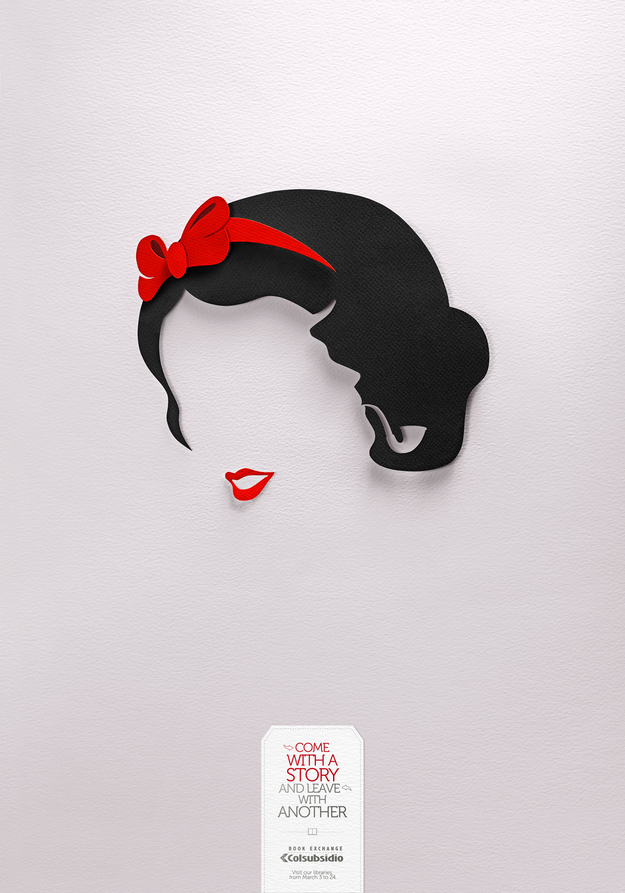
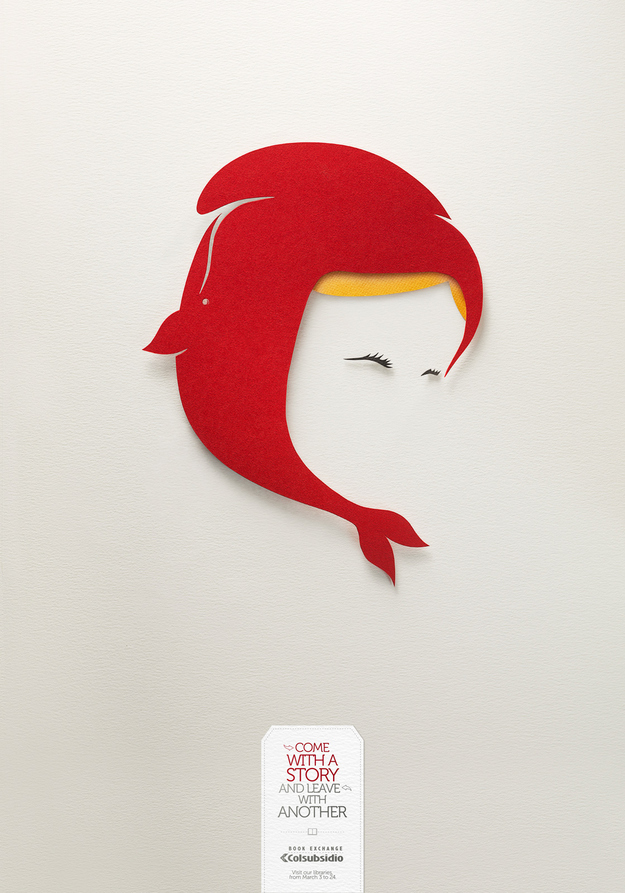
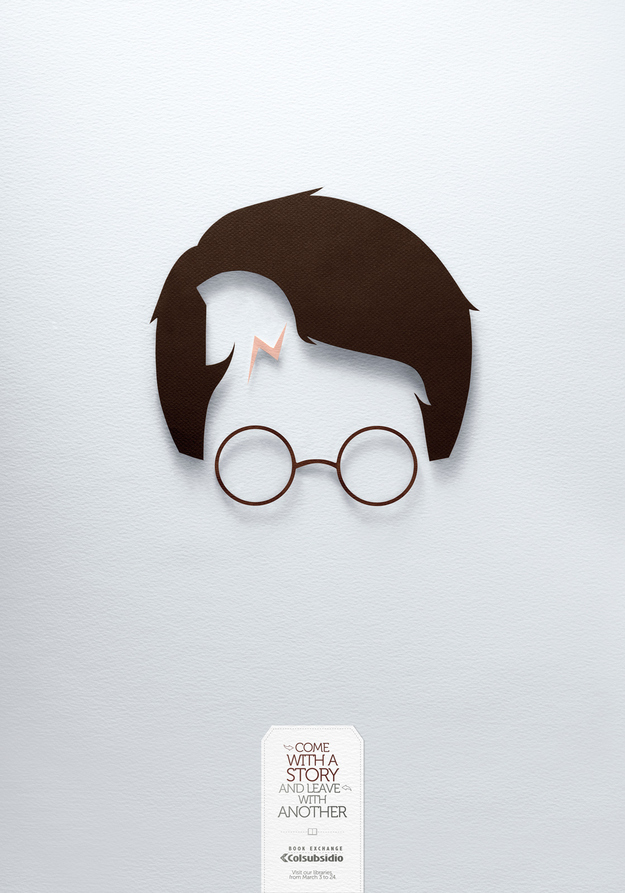
An ad campaign for Colsubsidio Book Exchange illustrating two stories in one image.
Agency: Lowe/SSP3

An ad campaign for Colsubsidio Book Exchange illustrating two stories in one image.
Agency: Lowe/SSP3
As an Anti-Twilight and Pro- Actual-Literature gal, I find this hilarious.
“The main problem with Twilight isn’t its sparkly vampires who lack all traditional weaknesses, or even its anti-feminist sensibility. When you get right down to it, the trouble is that the writing is terrible, filled with cliche phrases (“smoldering eyes”), repeated words (294 “eyes” in 498 pages) and the reductive characterization of its main characters (Bella is clumsy, and I guess she likes books. Or something).
On a recent car-trip with my husband and the writer Chip Cheek, we mulled over the question: What if great literary writers of the last 200 years had penned Twilight instead?
Herman Melville
“Call me Bella.” A tome about the length of the original series investigates Bella’s monomanical search for the vampire who stole her virginity. There’s an entire chapter devoted to describing the devastating whiteness of Edward’s skin, and several on the physiognomy of vampires, starting with their skeletal structure outward.
Virginia Woolf
The novel takes place over the course of twenty four hours, during which Bella is painting a portrait of Edward and reflecting on how her femininity circumscribes her role within 20th century society.
Cormac McCarthy
In the opening scene, Edward dashes Bella’s head against a rock and rapes her corpse. Then he and Jacob take off on an unexplained rampage through the West.
Jane Austen
Basically the same as the original, except that Bella is socially apt and incredibly witty. Her distrust of Edward is initially bourne out of a tragic misunderstanding of his character, but after a fling with Jacob during which he sexually assaults her (amusing to no one in this version) she and Edward live happily ever after.
George Saunders
Same as the original, but set in a theme park. Somehow involves gangs of robots, which distract the reader from the essential sappiness of Edward and Bella’s story.
Raymond Carver
Bella stars as the alcoholic barmaid with daddy issues that Edward, a classic abuser, exploits. When Bella’s old friend Jacob comes to visit and is shocked by her bruises, she thinks about leaving him, but instead hits the gin bottle. Hard.
Annie Proulx
Edward and Jacob defy society’s expectations up in the mountains.
Lewis Carroll
Bella takes acid and charts syllogisms.
James Joyce
Edward’s rapacious love for Bella reflects the way globalism has pillaged Ireland. It’s entirely written in Esperanto, with sections in untranslated Greek, except for Chapter 40, which is inexplicably rendered as a script page from the musical The Book of Mormon.
Dorothy Parker
Bella writes a brilliant takedown of the latest school play, dates a string of men, and repeatedly attempts suicide.
Kate Chopin
Stifled by her marriage to Edward, Bella has an affair with Jacob and then drowns herself.
Ernest Hemingway
Edward and Bella exchange terse dialogue alluding to Edward’s anatomical problem. Eventually, Bella leaves him for Jacob, a local bullfighter with a giant…sense of entitlement.
Flannery O’Connor
When Native American werewolf Jacob threatens her with death, Bella reconsiders her hardcore racism, and just for one milisecond, the audience finds her sympathetic.”
I don’t usually post text on here, but this poem by Pulitzer-winning Kim Addonizio is lovely.
 c.s.m.r.